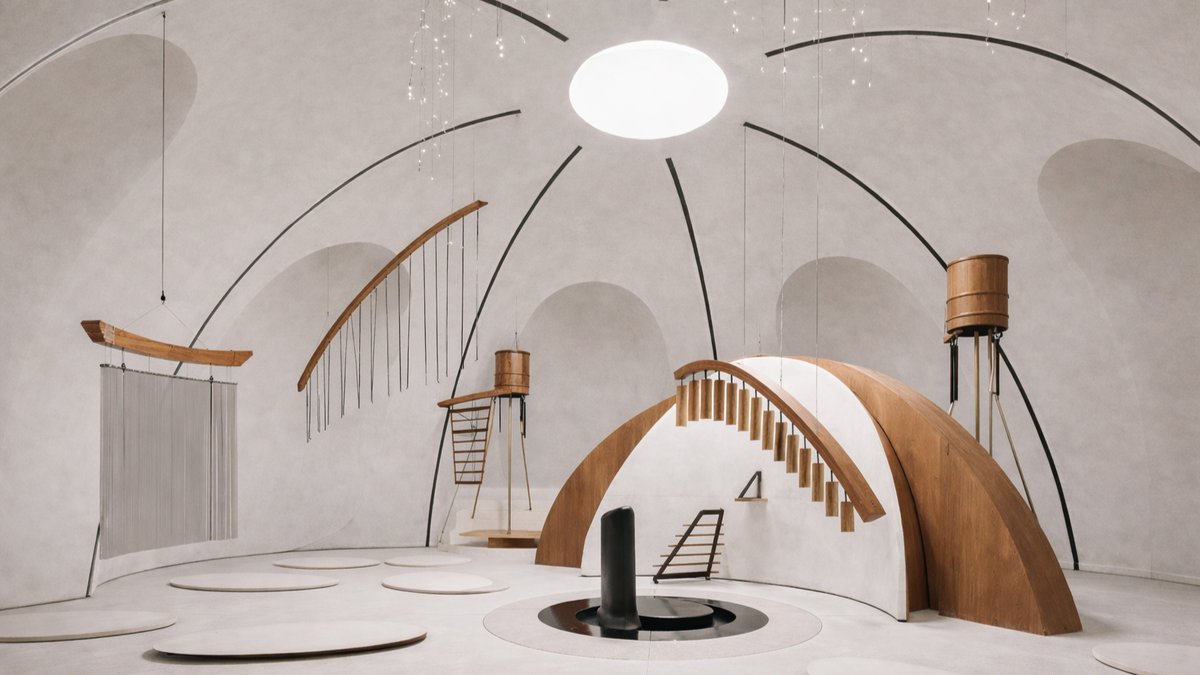
What happens when a world-famous composer focuses on wellness instead of just music? A.R. Rahman explored this idea by creating sound not only for entertainment but also for comfort, healing, and restoration. At Tulah Clinical Wellness in Calicut, this vision has taken shape as the Sonorium, an immersive sound experience inside the world’s largest sound-healing dome. The Sonorium was created in collaboration with Rahman’s Indian classical ensemble JHALAA. It is designed to use sound frequencies to support deep physical and emotional healing.
The Inspiration Behind Sonorium
The idea for the Sonorium began with a personal experience of Faizal E. Kottikollon, the founder of Tulah Clinical Wellness and a creator of wellness-focused spaces. As a student, he visited the Matrimandir in Auroville. There, he experienced sound not just as something he heard, but something he felt throughout his body. This experience stayed with him. He realized that while sound is usually treated as something passive, the body actually responds to it through vibrations and resonance. The Sonorium was created to connect these two aspects, hearing and feeling, into one powerful experience.
Also Read: 18 Amazing Buildings Designed by Women Architects
Collaboration with A.R. Rahman
The collaboration with A.R. Rahman happened naturally. The Sonorium was originally designed as a space for therapy and immersive experiences. However, when Rahman visited, he immediately connected with it, both acoustically and creatively. He brought his musicians into the space and recorded music there. This became a defining moment. It confirmed the high acoustic quality of the dome and showed that the space could also be used for creative music-making, not just therapy.
Design and Development
The Sonorium was developed through a collaboration between the Tulah team and Svaram, a studio that studies how sound and music affect the body, emotions, and communities. According to Aurelio C. Hammer, a sound therapist and creative director at Svaram who studies how sound influences the body and emotions, the dome may look simple from the outside, but inside it acts like a living instrument. The architecture, geometry, and sound are carefully combined to create a unique environment. Unlike traditional spaces that require guided sessions, the Sonorium allows a passive yet deep experience. The sound itself helps the body relax, activate, and balance the nervous system. At the same time, the space can be used for different purposes, such as listening, movement, therapy, and creative expression.
Structure and Acoustic Design
The outer dome of the Sonorium has a simple and familiar shape. However, the interior is specially designed with an additional layer that allows precise control over shape and proportion. This helps solve common acoustic problems found in domed structures. One important feature is its sevenfold inner structure. Although this design created geometric challenges, it also improved the space. It resulted in a slight asymmetry and uniquely shaped alcoves, which enhanced the overall acoustic performance.
Challenges in Building the Sonorium
Designing and building the Sonorium was not easy. It required a careful balance between acoustic science, architecture, and a deeper goal of making sound something that can be physically felt. Dhruv Dhingra, a sound engineer at Svaram, played a key role in developing the acoustic system of the dome. He explained that the process took more than two decades. It involved detailed acoustic simulations, testing of materials, and repeated design improvements to achieve the correct resonance and balance of sound.
Testing and Final Outcome
The final test of the Sonorium came after all the instruments were installed and the space could be fully experienced. A major moment was when A.R. Rahman recorded music there with a full ensemble. This confirmed the acoustic quality of the dome and showed that it could be used not only for healing but also for creative expression and group musical experiences.
Also Read: 9 Timeless Micro-Architecture Moments That Last Beyond Trends
A New Musical Experience
Working in the Sonorium was very different from working in a traditional music studio. Rahman found that the space changed the way music was created. It increased focus, improved listening, and encouraged a deeper connection between musicians. He explained that the silence inside the space makes people more aware of both sound and themselves. It allows deeper listening, and this changes how music is understood and performed. Even the smallest details in sound become clear. For Rahman, the experience was not only about creativity but also about achieving a sense of calm and alignment.
Healing Effects of the Sonorium
The main purpose of the Sonorium is to help the body return to its natural balance. Its effects develop gradually over time rather than instantly. People who experience it may notice better sleep, improved mental clarity, and more stable emotions. Most importantly, the Sonorium creates a deep sense of relaxation and restoration.
Comments (0)
Log in to share your thoughts
No comments yet
Be the first to share your thoughts!